Garay is a writing system created specifically for Wolof by Senegalese writer and artist Assane Faye in 1961. Unlike the Latin alphabet, which became the standardized writing system of modern Senegal, and Wolofal, which developed from the Arabic script through Islamic literacy, Garay was deliberately designed as a new script for Wolof.
It is therefore one of the more unusual chapters in the history of written Wolof. Rather than adapting an established writing system, its creator sought to develop a distinct script that could represent Wolof while also reflecting African linguistic and cultural identity.
Garay has never achieved the widespread use of the Latin alphabet, and its user community remains relatively small. Nevertheless, it represents an important attempt to create an indigenous writing system for Wolof and has developed a history of its own.
The creation of Garay
Garay was created by Assane Faye in Senegal in 1961, shortly after Senegal gained independence from France.
According to accounts of Faye’s work, the creation of the script was connected with the atmosphere surrounding Senegalese independence and the question of what an independent Senegalese cultural and intellectual identity could look like.
Faye was interested in creating a writing system that was specifically suited to African languages rather than simply relying on scripts inherited from European colonial institutions.
The script first appeared in published material in January 1961. (Unicode)
The circumstances surrounding its creation are particularly interesting because Garay emerged at almost exactly the moment when Senegal was becoming an independent state. Its history therefore belongs not only to the history of Wolof writing but also to the broader history of African cultural and linguistic experimentation during the period of decolonization.
A script created specifically for Wolof
Garay was not created as a modified version of the Latin alphabet.
Nor was it simply another form of Wolofal.
Faye designed a new set of characters and an orthographic system intended to represent Wolof. The script has some visual and structural inspiration from Arabic, but its characters are independently designed rather than being Arabic letters.
This gives Garay an unusual position among Wolof writing systems.
The Latin alphabet is based on a writing system that originated in Europe and subsequently became adapted for Wolof.
Wolofal is based on Arabic and belongs to the much broader Ajami tradition of adapting Arabic script to African languages.
Garay instead represents an attempt to create a new script specifically associated with Wolof and African linguistic circumstances.
Unicode’s documentation describes Faye as having designed Garay to be relatively easy for people familiar with Arabic script while giving it a simpler design. (Unicode)
Why does Garay look somewhat like Arabic?
One of the most immediately noticeable characteristics of Garay is that it is written from right to left, like Arabic.
Some of its visual forms also have an appearance that may remind readers of Arabic.
This was not accidental. Faye designed Garay with awareness of the Arabic-script environment in which Wolof had already been written for generations.
But Garay is not an Arabic alphabet.
Its letters are distinct, and unlike Arabic writing, Garay’s consonant characters are not joined together in the same way. The script has its own internal organization and conventions. (Unicode)
This makes Garay an interesting middle ground in the history of Wolof writing: visually reminiscent of an established West African writing tradition while being deliberately constructed as an independent script.
The structure of Garay
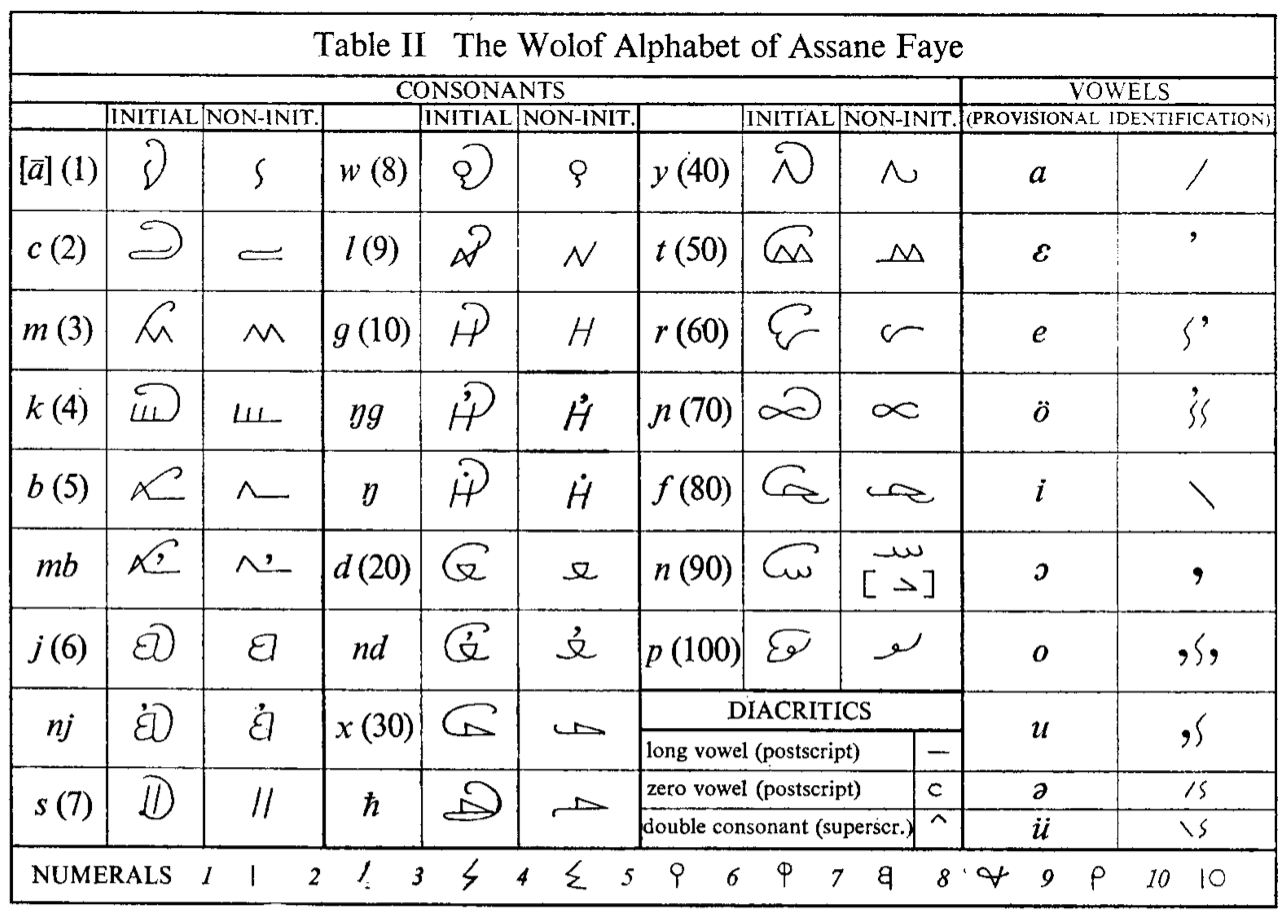
Garay is an alphabetic script written horizontally from right to left, with spaces between words.
The system contains a substantial inventory of consonant and vowel characters. Sources commonly describe it as having 25 consonant letters and 14 vowel letters or vowel-related signs, although the precise way its characters and signs are categorized can vary depending on how the system is described.
Unlike Arabic, the consonant letters are not connected into continuous words. Garay also includes conventions for such features as vowel length, gemination, and prenasalization. (Unicode)
The system was therefore intended to provide a relatively direct way of representing the structure of Wolof rather than forcing the language into the conventions of an unrelated spelling system.
For someone looking at Garay for the first time, however, its most important characteristic is not the individual inventory of letters. It is the fact that the entire script was designed as a coherent system rather than developing gradually through the adaptation of an older alphabet.
Garay and Wolof identity
The creation of Garay occurred during a period when questions of African identity, cultural independence, and the legacy of colonialism were particularly prominent.
This does not mean that Garay should be understood solely as an anti-European project. Its actual history is more complicated.
But the decision to create a new script for Wolof had an obvious cultural significance. A language could be written using a system that was neither the Latin alphabet inherited through European institutions nor the Arabic-derived script associated with Islamic scholarship.
Garay could instead provide a specifically African and Wolof-associated visual identity.
This aspect of Garay is important because writing systems can carry cultural associations beyond their practical function. The choice of script can communicate something about the historical tradition, community, institution, or cultural identity with which a text is associated.
Garay is therefore significant even though its number of users is much smaller than that of the Latin alphabet.
Garay and the other Wolof writing systems
Wolof is unusual in having three established writing traditions that have been used in different contexts:
| Writing system | Historical origin | Major associations |
|---|---|---|
| Latin | European/Latin script adapted and standardized for Wolof | Formal education, government, publishing, modern communication |
| Wolofal | Arabic-derived Ajami tradition | Islamic education, religious scholarship, poetry, manuscripts |
| Garay | Created by Assane Faye in 1961 | African/Wolof cultural identity, literacy experimentation, artistic and cultural use |
The three systems consequently represent very different histories.
Wolofal developed through centuries of Islamic literacy and became part of an established religious and literary tradition.
The Latin system developed through European contact and was subsequently standardized by the Senegalese state for modern national-language literacy.
Garay was deliberately invented in the postcolonial period as an alternative writing system.
Modern scholarship therefore commonly treats all three as part of the history of written Wolof, even though their levels of use are very different. A 2025 study of Wolof writing systems describes Latin, Wolofal, and Garay as the three systems used for Wolof, while noting that Latin is the official standard and that Garay has a much smaller role. (ResearchGate)
Garay in practice
Garay has never approached the widespread adoption of the Latin alphabet.
Its user community has remained relatively small, and its transmission has often taken place through informal teaching rather than through the formal educational system.
Nevertheless, Garay has been used for considerably more than demonstrations of the alphabet itself.
Assane Faye produced manuscripts in Garay covering subjects including textbooks, folktales, maps, mathematics, social morality, and animal stories. Researchers have also documented a Qur’an containing interlinear Wolof translations written in Garay. (Unicode)
These examples are important because they demonstrate that Garay was intended as a functioning writing system rather than merely as a symbolic collection of invented characters.
It could be used for ordinary educational and literary material as well as religious texts.
Garay and literacy
Faye continued teaching the script after its creation, and Garay has been used in informal literacy efforts.
Unicode’s documentation notes that the script has been taught informally for more than fifty years and has also been used by women’s groups and in adult literacy contexts, including for Mandinka as well as Wolof. (Unicode)
This illustrates one of the broader possibilities of Garay.
Although it was created for Wolof, Faye envisioned a system that could accommodate other African languages as well. Its design was therefore connected to a larger idea of developing writing systems that could work within African linguistic environments.
In this respect, Garay belongs to a wider twentieth-century history of African script creation.
Garay and the postcolonial period
Garay’s date of creation is especially significant.
The script appeared in 1961, only a year after Senegal’s independence.
That timing places its development within the first generation of postcolonial Senegalese cultural institution-building. The country was dealing with questions that many newly independent African states faced: How should national culture be represented? What role should colonial languages continue to play? How could African languages be developed for modern education and public life?
Garay was one response to those questions.
It was not the response ultimately adopted by the Senegalese state for general Wolof literacy. The Latin alphabet became the official standardized system.
But the existence of Garay demonstrates that the possibilities being considered at the time were broader than simply continuing colonial linguistic practices unchanged.
Garay and the Latin alphabet
The fact that Garay did not become the official writing system for Wolof does not make its creation historically insignificant.
Standardization is influenced by practical considerations as well as cultural ones. A writing system that already has extensive institutional support, printing infrastructure, educational materials, keyboards, fonts, and international technological compatibility has enormous advantages when a government is choosing a standard.
The Latin alphabet already possessed all of those advantages.
Garay, by contrast, had to build an entire ecosystem from the beginning.
Consequently, the modern dominance of Latin-script Wolof does not necessarily tell us everything about the cultural significance of alternative scripts. It tells us, among other things, which system became institutionally standardized.
Garay continued to exist outside that standard.
Garay in the digital age
One of the most important recent developments in Garay’s history has been its incorporation into modern digital standards.
Garay was added to the Unicode Standard, giving the script its own encoded characters and making it possible to represent Garay text digitally in a standardized way. Unicode assigns Garay the range U+10D40–U+10D8F. (Unicode)
This matters because Unicode support allows a writing system to move beyond images or specialized fonts.
Once characters are encoded, they can potentially be searched, stored, transmitted, indexed, displayed on compatible devices, and incorporated into digital language resources.
For a small writing tradition, this can make an enormous difference to its long-term preservation.
Digitization projects have also made some of Assane Faye’s manuscripts more accessible to researchers. Several of his handwritten texts were digitized in Dakar, including works covering subjects such as mathematics, moral instruction, animal stories, and political philosophy. (Cataloging Africana)
A script that almost disappeared from view
Garay occupies an unusual position in modern Wolof culture.
It was created specifically for the language, developed during the era of independence, taught by its creator and others, and used for substantial written works. Yet it never became the dominant way of writing Wolof.
For much of the modern world, Garay remained relatively obscure compared with both Latin-script Wolof and Wolofal.
Its inclusion in Unicode has changed that situation somewhat. The script can now be represented as actual text rather than existing only in photographs, scans, specialized fonts, or handwritten manuscripts.
This gives Garay a new technological context that its creator could not have anticipated in 1961.
Why Garay matters
Garay is important not because it replaced the other ways of writing Wolof, but because it demonstrates that the history of Wolof writing has never been limited to a single alphabet.
The Latin alphabet represents the modern standardized tradition.
Wolofal represents a long tradition of Arabic-based literacy, Islamic scholarship, and Wolof literature.
Garay represents something different: the deliberate creation of a new writing system in post-independence Senegal.
Its relatively small user base should not obscure the significance of that experiment.
Garay demonstrates that writing systems can be created as acts of linguistic and cultural design. A language does not necessarily have to inherit one fixed script. Communities and individuals can adapt existing systems, create new ones, or maintain several systems simultaneously for different purposes.
For Wolof, this has produced an unusually rich history of writing.
From oral tradition, to Wolofal, to the standardized Latin alphabet, to Garay, the written history of Wolof reflects changing relationships among language, religion, education, colonialism, independence, cultural identity, and technology.
Garay is one of the most distinctive parts of that history: a script born in the first years of independent Senegal, designed specifically for Wolof, and still preserved today as a unique example of modern African script creation.
Alphabet





You must be logged in to post a comment.