The Garay alphabet is a modern script created specifically for writing Wolof, the widely spoken language of Senegal, The Gambia, and parts of Mauritania. Invented in the 1960s by Senegalese artist and writer Assane Faye, the Garay alphabet represents a significant effort to develop an indigenous writing system tailored to Wolof’s phonetic and cultural characteristics.
Although not as widely used as the Latin alphabet or the Ajami script, Garay is a symbol of linguistic and cultural pride, showcasing a uniquely African approach to writing.
Origins of the Garay Alphabet
The creation of the Garay script was driven by a desire to provide Wolof with a writing system that was both culturally authentic and suited to its phonetics.
- Assane Faye’s Vision: Inspired by African heritage and the idea of linguistic independence, Faye sought to design a script that reflected Wolof identity and was distinct from the colonial Latin script and the Arabic-based Ajami script.
- Date of Creation: The Garay alphabet was introduced in 1961 and represents one of the few completely new scripts designed for an African language.
Structure of the Garay Alphabet
The Garay script is a phonetic alphabet, meaning that its symbols correspond to the sounds of the Wolof language.
- Letters and Sounds
- The alphabet consists of 25 letters, each representing a specific consonant or vowel sound in Wolof.
- Unlike the Latin alphabet, Garay was designed to fit Wolof’s unique phonetic characteristics without relying on adaptations from other scripts.
- Writing Direction
- Garay is written from right to left, similar to Arabic, but it is distinct in its design and functionality.
- Garay is written from right to left, similar to Arabic, but it is distinct in its design and functionality.
- Design and Aesthetics
- The script has an elegant, flowing appearance, reflecting Faye’s artistic background.
- Each symbol is visually distinct, making the script both practical and visually appealing.
Advantages of the Garay Alphabet
- Cultural Authenticity
- Garay emphasizes Wolof identity by providing an indigenous writing system rooted in African creativity rather than foreign influence.
- Garay emphasizes Wolof identity by providing an indigenous writing system rooted in African creativity rather than foreign influence.
- Phonetic Precision
- Symbol of Independence
- Garay is a statement of self-reliance, symbolizing freedom from colonial and external linguistic systems.
Challenges to Adoption
Despite its innovative design, the Garay alphabet has faced several obstacles that limit its widespread use:
- Competition with Existing Scripts
- The Latin alphabet is dominant in formal education, media, and technology.
- Ajami remains culturally significant in religious contexts.
- Lack of Institutional Support
- Governments and educational institutions have not officially adopted Garay, limiting its presence in schools and literacy programs.
- Governments and educational institutions have not officially adopted Garay, limiting its presence in schools and literacy programs.
- Limited Awareness and Resources
- Few resources, such as books, teaching materials, or digital tools, are available in Garay, making it difficult for learners to access and use the script.
Garay in Contemporary Contexts
While not widely used, Garay remains a subject of interest among linguists, cultural enthusiasts, and advocates for African scripts.
- Revival Efforts
- Some cultural organizations and individuals work to promote Garay through workshops, publications, and online content.
- The script is celebrated as an important part of Senegal’s linguistic heritage.
- Artistic and Symbolic Value
- Garay has inspired artistic works, symbolizing Wolof pride and cultural innovation.
- Garay has inspired artistic works, symbolizing Wolof pride and cultural innovation.
- Research and Documentation
- Linguists and historians continue to study and document the script to ensure its preservation and to explore its potential applications.
The Significance of Garay
The Garay alphabet stands as a powerful example of linguistic creativity and cultural affirmation. It represents the idea that languages, especially those with oral traditions like Wolof, can be given unique and appropriate written forms that honor their distinctiveness.
While Garay is not yet a practical alternative to the Latin or Ajami scripts, its existence enriches the narrative of Wolof’s linguistic journey. As interest in African languages and indigenous scripts grows, the Garay alphabet serves as a reminder of the potential for innovation in preserving and celebrating linguistic heritage.
Alphabet
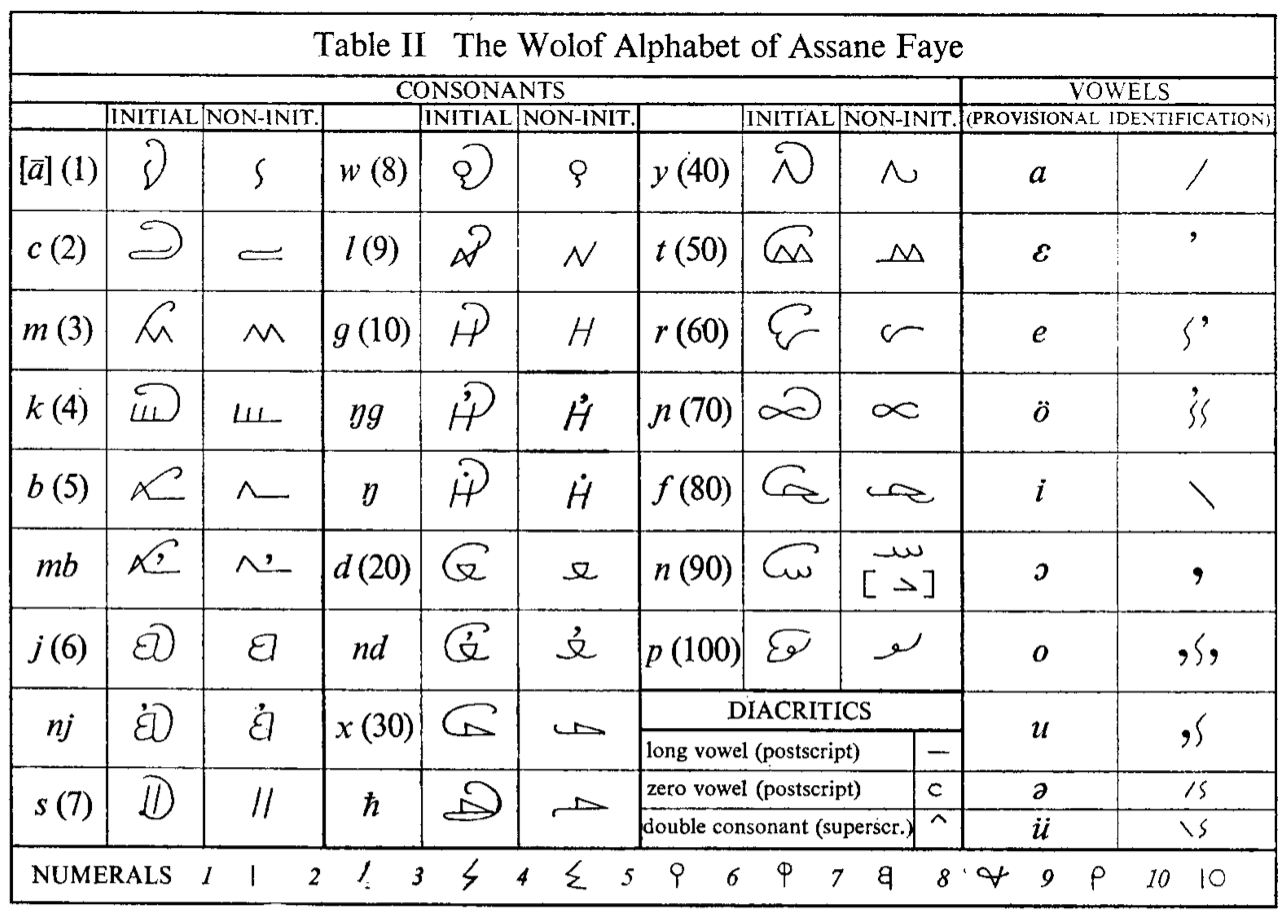
Chart of Assane Faye’s alphabet (from Dalby 1966: Table 2).
Conclusion
The Garay alphabet is more than a writing system—it is a symbol of identity, independence, and cultural pride. Although it has not achieved mainstream adoption, it remains an inspiring example of how a language can be uniquely expressed in written form. As efforts to preserve and promote indigenous scripts continue, Garay holds the promise of contributing to the broader appreciation of Wolof and African linguistic diversity.





 Janga Wolof
You must be logged in to post a comment.